

[Press] Sound, Freshness, and the Fight Against Food Loss — A New ONTSUBU Experiment
Research & Press — June 15, 2026
Sound, Freshness, and the Fight Against Food Loss — A New ONTSUBU Experiment
ONTSUBU LLC (USA · founded by Miyuki Tani, FRSA) has launched a research project applying its original acoustic theory to agriculture and food. The experimental goals are to enhance umami and extend freshness; the longer-term development goal is implementation in home appliances and agricultural infrastructure.
A Contradiction Worth Solving
In 2023, roughly 733 million people — about one in eleven worldwide — faced hunger, according to the UN’s five-agency report. Yet the deeper problem is often not that food is scarce, but that it doesn’t arrive, or is thrown away. In Japan alone, food loss reaches an estimated 4.72 million tonnes a year, much of it traced back to a single issue: freshness.
Extending the freshness window does more than reduce waste. It widens transport range, frees up shipping timing, and raises brand value — and if fermentation microorganisms can be stabilized, it points toward more uniform organic fertilizer and farming that depends less on chemical inputs. ONTSUBU’s approach — controlling freshness and fermentation through sound — offers a new angle on this challenge.
Why Would Sound Act on Soil and Food?
Plants respond to sound. Microorganisms change their growth rate in response to vibration. These are phenomena increasingly confirmed in peer-reviewed research: certain sounds suppress spoilage bacteria and extend the shelf life of strawberries, and playing sound to brewing yeast has been shown to shift its aromatic profile. Some studies even suggest that organisms emit vibration themselves, communicating with neighboring cells.
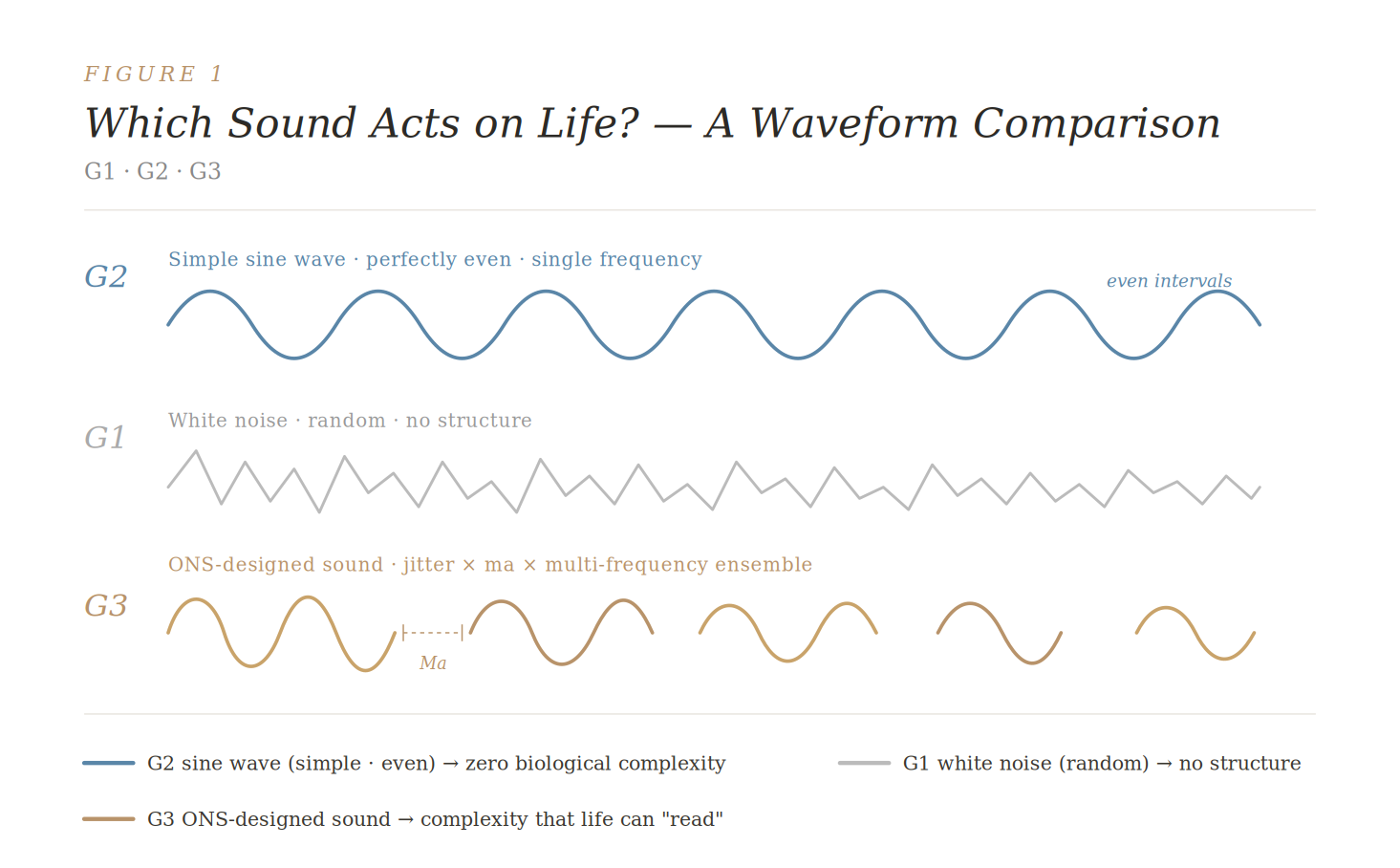
But one decisive question remains. Prior experiments have almost all used simple sine waves or single fixed frequencies — leaving open the question of which sound, and which rhythmic pattern, most strongly draws out a biological response. ONTSUBU’s original theory defines vibration patterns built from temporal fluctuation (jitter), ma (interval), and ensembles of multiple frequencies. The hypothesis: this “designed complexity” — neither pure randomness nor pure regularity — is the sound that acts most powerfully on living systems.
Sound × Fermentation — A Second Frontier
The same mechanism may extend beyond freshness to the fermentation industry. In one study, brewing yeast exposed to audible sound for 50 hours showed significant changes in growth rate, biomass, and aroma compounds (Frontiers in Microbiology, 2021). With organic fertilizer demand rising as chemical fertilizer prices climb, stable microbial activity has become a barrier to adoption — and a point of growing interest in this research. Anticipated applications include accelerating and stabilizing the fermentation of food residues, making organic fertilizer quality more uniform, and activating soil microorganisms.
The Origin of the Hypothesis
The idea that “life can read complex vibration” grew out of founder Miyuki Tani’s experience as a professional drummer. Performing internationally since her early twenties alongside musicians from around 100 countries — including Grammy-nominated artists — she felt firsthand that fine, complex rhythms reach everyone in the room. If rhythm moves people, she reasoned, it should also act on microorganisms, plants, and food. A licensed Professional Engineer (the Japanese national Gijutsushi qualification in urban and regional planning), she spent seven years developing this into a theory: that complex vibration carries a physical force capable of moving the cells and water within living things.
Full scientific grounding, prior literature, and the experimental protocol are detailed in the two white papers. The press release is available on PR TIMES. ONTSUBU welcomes inquiries from companies and research institutions interested in development or investment.
- [Now Open] — OTOKAERI: Come Home to Yourself in a Kagoshima Forest, Summer 2026
- [Fully Booked] Sound Bath Program in Kagoshima — Summer 2026