

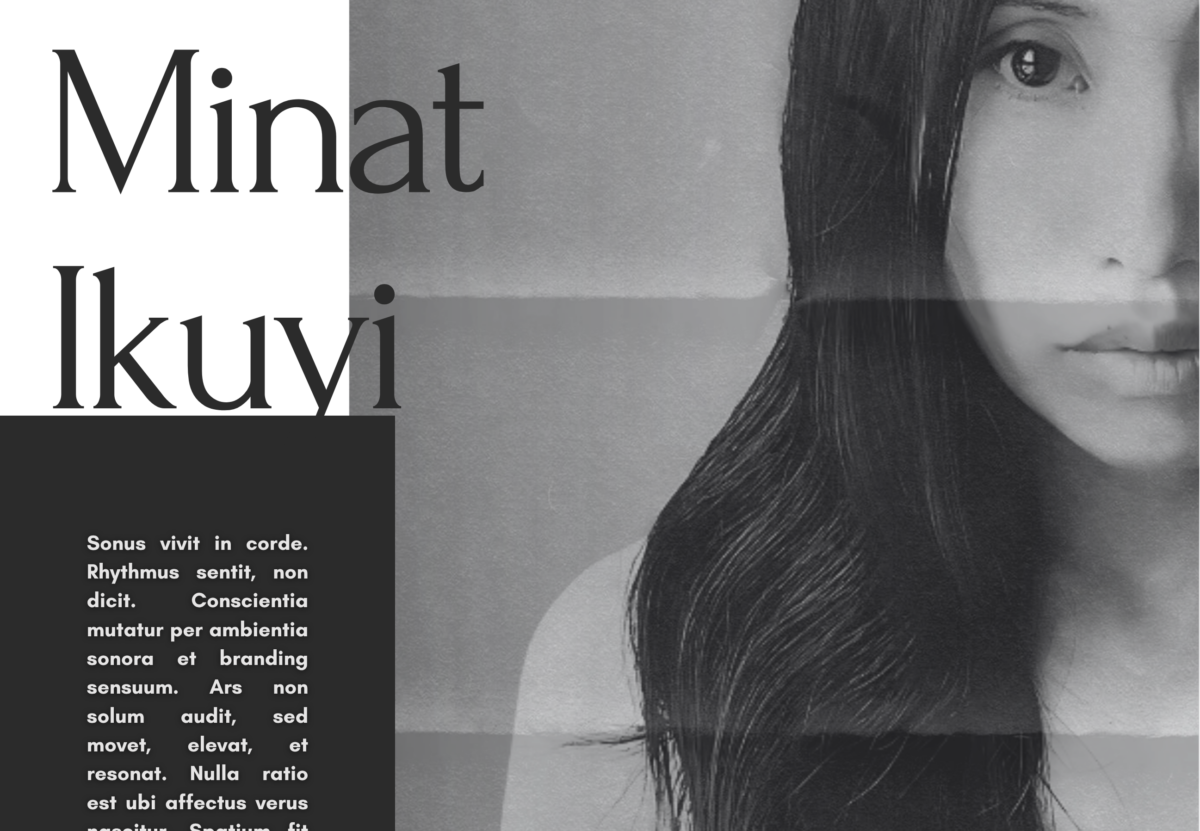
Artist Story – Miyuki Tani (Ikuyi Minat)
I lost my father when I was nine.
It was the first great loss of my life.
In a world without the father I loved so deeply,
I couldn’t see the meaning of staying alive.
As a child, I seriously thought about leaving this world too.
And yet—there was one thing that kept me here:
I wanted to protect my mother and my siblings.
That single wish was the reason I chose to stay.
What slowly filled the deep void inside me was music.
Every time I touched an instrument and played a rhythm,
the world that had come to a stop began to regain a sense of life—a quiet, fragile breath.
Like the tiny flames in The Little Match Girl,
whenever music was playing,
I could remember what it felt like to be happy.
So I made a promise to myself:
I would never let that small flame go out.
I trained my sensitivity and my own philosophy by myself,
and from childhood I practiced
“mental training for the day I become a musician”
every single day.
At 19-years-old, I discovered the drums.
At 25-years-old, I was scouted by a music agency in the United States.
The door to my dream was, without question, starting to open.
But right after that,
a family member suffered a severe disability
due to abuse in a welfare facility.
In that moment, I chose not
“a life where I simply continue my music,”
but “a life where I protect my family.”
It was not about giving up on music.
It was a decision about how to remain honest as a musician.
Music played while betraying my own family
could never carry the power to truly move someone’s heart.
So I chose integrity.
After that, I passed a highly competitive national Professional Engineer qualification (P.E.Jp)
on my first attempt,
and from the outside, my life looked “successful” and steady.
But deep inside, I kept thinking:
My life is moving forward,
but the part of me that loves music the most
is being left behind.
So I refused to give up.
After work, night after night, I kept playing improvised live sets—
365 days a year.
Work, daily life, family,
and international development projects in the field.
Even while flying around the world, through 11 different cities,
there was one thing I never let go of:
The drums.
The drums were my way of surviving.
After moving to the United States and giving birth,
I picked up my sticks again in the small gaps between childcare.
The moment I did,
the sound that had been asleep for so long
rose up again from deep within my body.
In that instant, I understood:
I am not “going back” to who I used to be.
From here, I will be born again as an artist.
And then, a new trial appeared.
I developed drummer-specific hyperacusis.
My body could no longer tolerate loud sounds.
The time I could listen to music each day became limited,
and I spent most of my life—even when sleeping—
wearing special earplugs.
Even so, I did not stop.
Quiet electronic drum recordings at very low volume.
Sound design.
Painstaking, detailed production work.
Within those constraints,
I began to rebuild a new kind of musician’s body.
There is only one reason I keep going:
The drums are the embodiment
of every minute I have survived up to now.
So I play.
Within limited time, with limited sound,
I turn pain, loss, journeys, prayers, and strength
into sound for the future.
This is not just the story of one drummer.
It is the story of a life that was saved by sound,
lived through sound,
and connected to the world by sound.
It is, in itself,
a proof of life.